
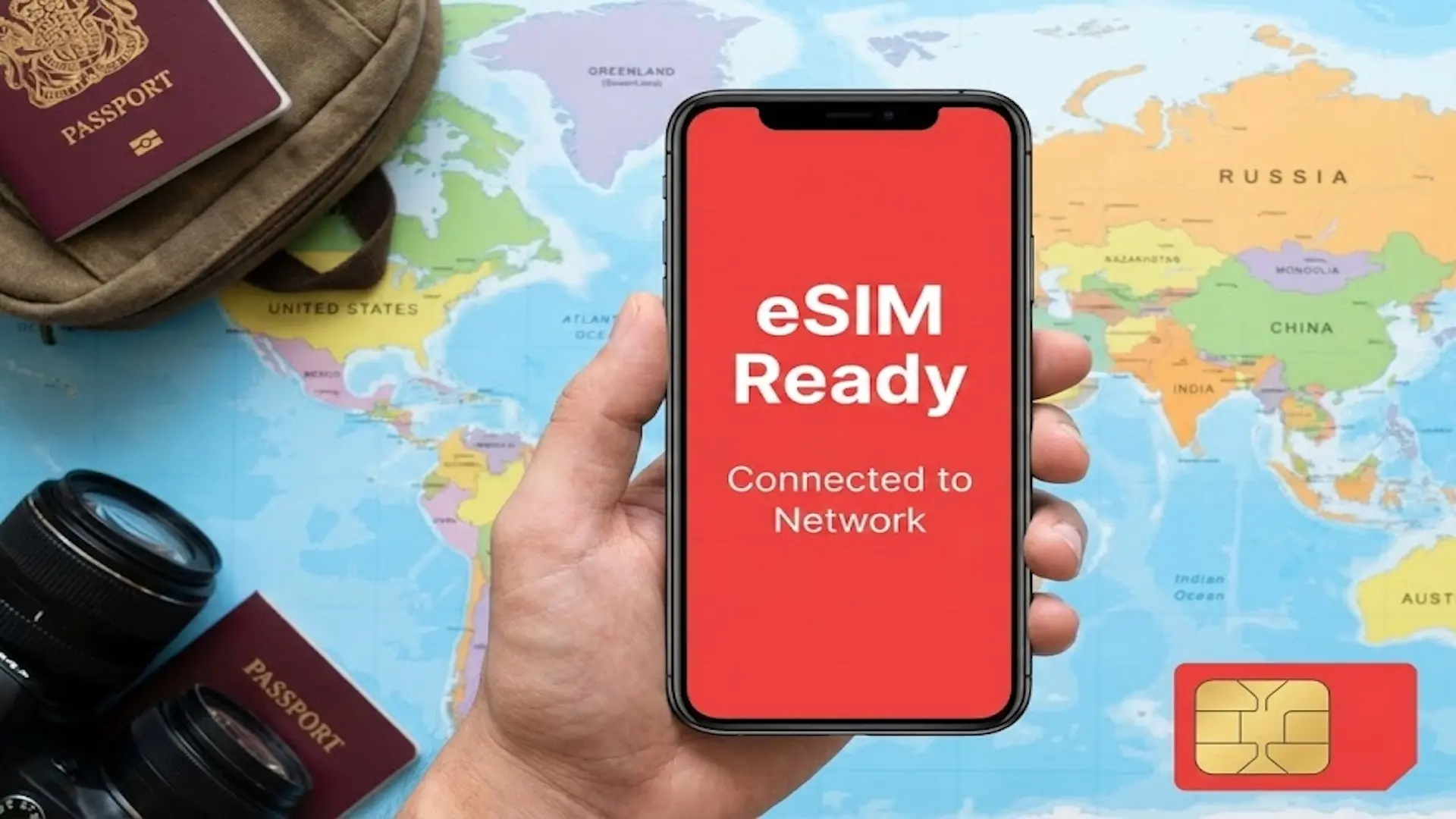
 eSIM Guides
February 15, 20264 min
Is My Phone eSIM Compatible? Check in 2 Seconds (2026 List)
Four reliable methods to quickly check if your smartphone supports eSIM (simulator, settings, #06# code, etc.)

eSIM vs SIM card? Both do exactly the same job: they connect your phone to your carrier's network so you can make calls, send texts and use the internet. Only the format changes: one is a small plastic chip you insert, the other, the eSIM, is already built into the smartphone and is activated remotely.
In this article, we compare the two point by point: setup, device compatibility (iPhone, Samsung Galaxy, Google Pixel), security, multiple profiles, price, signal, battery and use abroad. You'll also see how to activate an eSIM, how to keep your usual number alongside it, and which option to pick depending on your mobile plan, how you use your phone and where you're going.
Information on compatible models comes from Apple's and Google's support pages, and voilà eSIM prices were checked on our website: the main sources are listed at the bottom of the page.


SOUTH KOREA
active
20 Go
remaining
Operator
SKTelecom, LGU+
Expires
In 3d • Jun 12
Top up

THAILAND
active
20 Go
remaining
Operator
AIS
Expires
In 3d • Jun 12
Top up

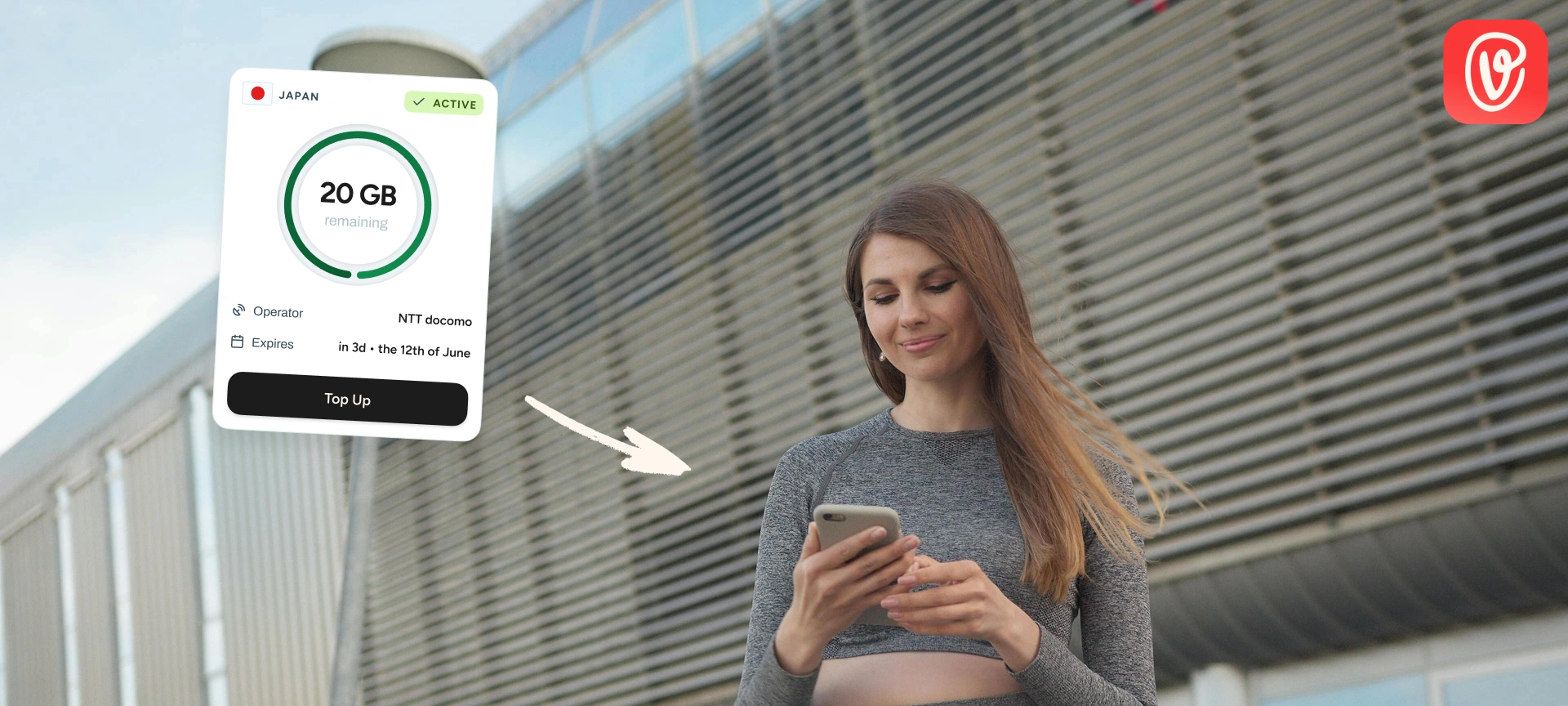
JAPAN
active
20 Go
remaining
Operator
NTT docomo
Expires
In 3d • Jun 12
Top up
No blocked apps
Tethering enabled
24/7 customer support
No blocked apps
Tethering enabled
24/7 customer support
Travel abroad with confidence: no more roaming fees, connection struggles, or unexpected top-ups. With a travel-friendly eSIM, stay connected everywhere, stress-free and surprise-free.
The difference fits in one sentence: the physical version is removable and slides into the phone's tray, while the eSIM is soldered into the device and your plan is loaded onto it remotely.
Otherwise, they do the same thing. Each one holds the information that identifies you: your number, your authentication keys and your plan. Once it's up and running, nothing changes in everyday use: calls, texts and mobile internet on 4G or 5G.
What really changes is how you get it, set it up and replace it:

The SIM card (short for Subscriber Identity Module) is the small smart card carriers have been handing out since GSM arrived in the early 1990s. It identifies the user on the network: without it, there are no calls and no mobile data.
Over the years, the traditional SIM card has shrunk to make room for other components:
It usually comes as a “triple cut” SIM: you pop out the size that fits your device. To install it, you open the tray with a paperclip or the tool supplied, place the chip in it, and the phone recognizes it within seconds.
The eSIM (short for “embedded SIM”) is a chip soldered into the phone that does the same job. It's also called an eSIM card, a virtual SIM or a digital SIM. Instead of inserting anything, you download a profile that contains your plan.
eSIM technology is found on smartphones, but also on tablets, smartwatches such as the Apple Watch, and some laptops. Each device has its own identifier, the EID number, which is sometimes requested to prepare your profile.
To understand the technology in detail, we wrote a full article on what an eSIM is.
An eSIM works like a SIM card, with no chip to handle: it's a rewritable component, soldered into the phone, that receives one or more profiles remotely. That's why it's also called a virtual SIM card.
In practice, here's what happens when you add an eSIM:
Once the eSIM is installed, calls, texts and mobile internet work just as before. You can keep several profiles and turn on the one you need, for example one for home and another for a trip.
While their role is identical, the eSIM and the SIM card differ on five practical points.
A classic SIM is an object: you have to get it from a store or by mail, then insert it by hand. The eSIM is already in your phone: you download your plan from the settings, and everything is ready in a few minutes. That's its main strength: fast activation, even on the other side of the world, without looking for a store.
A classic SIM card works in every cell phone, from the oldest to the newest, as long as the size fits. The eSIM needs a compatible device: that's the case for most high-end and mid-range smartphones, but not for every entry-level model.
With a plastic SIM, switching carriers or plans often means receiving a new card and swapping it in the tray. With an eSIM, you add, turn off or delete a plan in a few taps, with no delivery to wait for.
That little rectangle can be removed in seconds by a thief, who then cuts off your line and can use it in another device. An eSIM can't be removed: your phone stays reachable and trackable for longer, and your line can't be moved without going through your provider.
A physical chip carries only one plan. An eSIM can store several: according to Apple, an iPhone can handle eight or more eSIMs. Most current smartphones also support dual SIM mode, with two active lines at once: personal and work, or everyday and travel.
Here's the gist of the eSIM vs SIM comparison, criterion by criterion.
| Criterion | Plastic SIM | eSIM |
|---|---|---|
| Format | Inserted into the tray (nano, micro or mini) | Built into the phone |
| How you get it | Store, retailer or mail | Online, instant delivery |
| Setup | By hand, in the tray | With a QR code or an app |
| Time to activate | Instant in store, a few days by mail | A few minutes |
| Compatibility | All phones | Compatible devices only |
| Number of plans | Just one | Several profiles |
| Switching phones | You slide it into the new device | Transfer from the settings or through customer service |
| Changing plans | New card to wait for | In a few taps |
| Security if the phone is stolen | Removable | Can't be removed |
| Signal and speed | Identical | Identical |
| Use abroad | Local plan to buy on arrival | Plan installed before you leave |
The plastic SIM still has real strengths, especially if your phone is a few years old.
Its strengths
Full compatibility: it works in every phone, including older models and entry-level ones.
Switching phones in one move: you take it out and slide it into the new device, no paperwork needed.
Easy fallback: if your phone breaks down, you put it in another one and get everything back.
Available on the spot: in many countries, you can find a prepaid plan from local carriers, in a store or at the airport counter.
The limits of the physical format
Loss and damage: it's easy to lose when you handle it, and it wears out with use.
Waiting time: you have to wait for delivery or go somewhere to get a new one.
A single plan: to have two numbers, you need a phone with two slots.
Exposed to thieves: it can be removed, cutting off your connection in seconds.
A plan bought at the airport or from local sellers may also require ID, often your passport, depending on the country's regulations.
Compared with a SIM card, the eSIM mainly brings flexibility and speed.
The advantages of an eSIM over a SIM card
Fast activation: you buy your plan online and you're connected in a few minutes, with nothing physical to do.
Multiple profiles: a single eSIM can hold several plans, and you switch from one to another in the settings.
Two plans on one phone: you keep your usual plan and add an eSIM alongside it, for work or for your trips.
More secure: it can't be removed or lost, which makes a thief's job harder.
No contract: an international eSIM is bought one plan at a time, with no minimum term.
Less plastic: no card, no packaging, no shipping.
More space inside the phone: without a tray, manufacturers free up room, for the battery for example.
What to know before choosing an eSIM
Compatible device required: the eSIM doesn't work on phones that are too old.
Less immediate transfer: switching phones goes through the settings or customer service, not a simple swap.
Every disadvantage of the eSIM is easy to handle, as long as you know about it before you choose.
None of these issues is a deal-breaker: they just take a bit of planning, especially before replacing your phone.
Yes, for most travelers, an eSIM is more convenient than a local plan bought on arrival. You buy your plan before you leave, install it at home over Wi-Fi, and you have internet as soon as you land, without hunting for a shop at the airport.
What an eSIM changes abroad:
Buying locally still makes sense for a long stay in a single country, with a large amount of data or a local number. For a few days to a few weeks, an eSIM is more comfortable. In the UK, for example, prepaid plans all last 30 days, even for a weekend: we compare every option in our article on choosing a UK SIM card.
Outside of travel, an eSIM generally costs about the same as a SIM card: it's the plan that makes the difference, not the format.
Depending on the carrier, the physical version is free or charged when you order it, and the eSIM is often free, sometimes offered as a paid option. Check the price on your carrier's rate sheet before signing up.
When you travel, the comparison is different: you need to weigh a travel eSIM against a plan bought locally and your own plan's international options. A local plan can be cheap, but it takes some effort and sometimes ID. Outside the area your plan covers, international passes are expensive: an eSIM usually works out cheaper.
With voilà eSIM, plans range from 1 to 50 GB, with no subscription and no contract. A few examples of prices checked on our website:
| Destination | 1 GB, 7 days | 5 GB, 30 days |
|---|---|---|
| [Europe (33 countries)](https://voilacreators.com/en/esim-europe/) | $1.30 | $5.80 |
| [Japan](https://voilacreators.com/en/esim-japan/) | $1.40 | $5.50 |
| [United States](https://voilacreators.com/en/esim-usa/) | $1.70 | $6.80 |
It's one of voilà eSIM's strengths: excellent value for money, with the final price shown before you buy, no hidden fees and no contract.
No, an eSIM isn't compatible with every device, whereas a SIM card is. You need a phone with an eSIM chip, which is the case for most smartphones from recent years.
Many people already have a compatible phone without knowing it. On an Apple phone, if the “Add eSIM” option appears on screen under “Cellular”, that's a good sign. To check your device, the full list is on our eSIM compatible devices page.
Some iPhones no longer have a tray: they work with eSIM only. According to Apple:
With one of these models, the choice is made for you: the eSIM is the only option. Our page on the iPhone Air and eSIM explains how it works.
Check in seconds whether your smartphone supports eSIM before choosing between an eSIM and a SIM card.
There are two ways to get an eSIM: ask your usual mobile carrier for one for everyday use, or buy an international eSIM online for a trip. Either way, everything is done remotely or from an app, without going anywhere.
A local eSIM is sold by a mobile carrier at your destination. It can be worthwhile for a long stay, but you often have to buy it on site or on a website that isn't translated, sometimes with ID required. Not every carrier offers it to tourists: some still reserve eSIM for their subscribers.
An international eSIM is ordered before you leave, from a specialized provider. It comes for a single destination, for a region such as Europe or Asia, or for the whole world. That's the case with voilà eSIM: you choose your destination in the app, you pay, and your eSIM is ready to install in a few minutes, with 24/7 human customer support if you need help.
To activate an eSIM, you need a compatible phone, an internet connection (Wi-Fi or mobile data) and the QR code or app that comes with your plan. Here's each step:
With voilà eSIM, installation takes two minutes from the app, which then lets you track your data in real time. All the details are in our article on how to install an eSIM.
No, you don't get better or worse signal with an eSIM than with a SIM card. Both only store your credentials: it's the phone's modem and antennas that pick up the network, and they're the same either way.
With the same carrier, coverage, speed and call quality are therefore identical, whether you're watching a video or browsing. If your connection changes when you switch from one to the other, the cause lies elsewhere:
On the ground, what matters most is the choice of network: voilà eSIM connects to the country's local networks, with 5G where available.
No, an eSIM doesn't use more battery than a classic SIM: the chip itself uses very little power, and it's the network connection that affects battery life, whatever the format.
What can make a difference is the number of active plans. With two lines on at the same time, your phone monitors two networks, which can slightly increase power use. If you don't need your usual plan during your trip, you can turn it off temporarily in the settings, without removing anything.
A weak network also wears down the battery: when the signal is poor, the phone boosts its power to stay connected, whether you're streaming video or browsing. Here again, the type of SIM makes no difference.
Yes, and it's often the best option: you keep your SIM card for your usual number, and you add a travel eSIM for the internet. Nothing to remove, nothing to change.

How to set up your phone for dual SIM:
That's exactly what voilà eSIM offers: a data eSIM to add alongside your current plan, easy to manage from the app. To understand what uses up your data and how to track it, read our article on mobile data.
To make the right choice, check three things, in this order:
The first two points decide what you keep day to day. The third shows that the two options aren't mutually exclusive: most people are better off combining their usual SIM with an eSIM.
To choose between a SIM and an eSIM, start with your phone, then with how you use it.
| Your situation | The best choice |
|---|---|
| Your phone isn't eSIM compatible | Physical SIM, it's the only option |
| You have an iPhone with no tray | eSIM, it's the only option |
| You often switch phones | Physical SIM, easier to move |
| You want to keep personal and work separate | eSIM on top of your current plan |
| You want to use it right away | eSIM, active in a few minutes |
| You're going abroad | Travel eSIM, while keeping your line |
For your main plan, the choice mostly depends on your offer and on how you switch phones. For a second plan, and especially for traveling abroad, an eSIM is almost always more convenient.
The answer changes depending on where you're going. To get the best connectivity at the best price:
So for most trips, the right answer is: your usual line for calls, and a cheaper travel eSIM for the internet. voilà eSIM covers more than 200 destinations, and travelers choose it for three reasons:
SOUTH KOREA
active
20 Go
remaining
Operator
SKTelecom, LGU+
Expires
In 3d • Jun 12
Top up
THAILAND
active
20 Go
remaining
Operator
AIS
Expires
In 3d • Jun 12
Top up
JAPAN
active
20 Go
remaining
Operator
NTT docomo
Expires
In 3d • Jun 12
Top up
No blocked apps
Tethering enabled
24/7 customer support
No blocked apps
Tethering enabled
24/7 customer support
Travel abroad with confidence: no more roaming fees, connection struggles, or unexpected top-ups. With a travel-friendly eSIM, stay connected everywhere, stress-free and surprise-free.
Rony is our in-house travel-connected expert. Always curious and never too far from an airport, he explores the latest destinations while testing the newest eSIM solutions. He signs our articles on travel and mobile technology, with a single mission: to turn his discoveries into clear, reliable, and smart advice to accompany you anywhere in the world.
See all articleseSIM GuidesFour reliable methods to quickly check if your smartphone supports eSIM (simulator, settings, #06# code, etc.)
 eSIM Guides
To set up an eSIM on your phone: Settings > Cellular Data > Add an eSIM Card. Installation takes just a few clicks.
 Mobile connectivity
Mobile data is your phone's internet connection without Wi-Fi: how it works, how to turn it on (iPhone and Android), usage by activity and charges abroad.